
1/114 Merrindale Dr
Croydon South, VIC 3136
(03) 8799 2974
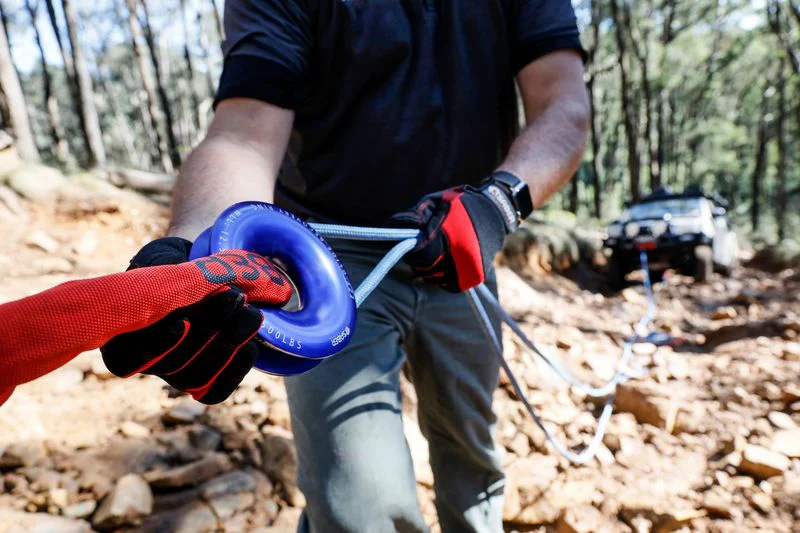
When you’re winching a 4×4 or towing a loaded vehicle off the track, every part of your recovery system matters — and that includes your recovery ring. A well-designed ring can make the difference between a smooth, efficient recovery and one that damages your rope or gear.
That's why Saber Offroad built the Ezy-Glide Recovery Ring from the ground up. Not rebadged. Not built to a price. Purpose-designed for the real-world demands of 10–12 mm synthetic winch ropes and soft shackles.
By engineering from first principles — analysing rope mechanics, bend radius requirements, and friction behaviour — Saber created a larger-diameter, thick-section ring with a unique internal channel that supports both a moving winch line and a static soft shackle. The result? Better rope health, smoother operation, and superior longevity.
Every rope loses strength when it bends. The tighter the bend, the higher the fibre stress — and the greater the loss in performance. This relationship is defined by the D:d ratio, the ratio between the diameter of the object the rope bends around (D) and the rope's own diameter (d).
Industry standards are clear: small bend radii shortens rope life. Government hoisting manuals note that undersized hooks or sheaves can cut sling efficiency by up to 50 %. Synthetic rope manufacturers like Samson recommend at least 3:1, ideally 4:1 or greater, and many splicing guides advise 6:1 or more for long-term durability.
Independent testing in the off-road space echoes those numbers. The consensus is that a moving rope (dynamic bend) should wrap around roughly 7–8 × its diameter, while a static bend (like a soft shackle seated in a ring) can be about 2–3 ×.
For example:
These are the numbers Saber used to shape the Ezy-Glide.
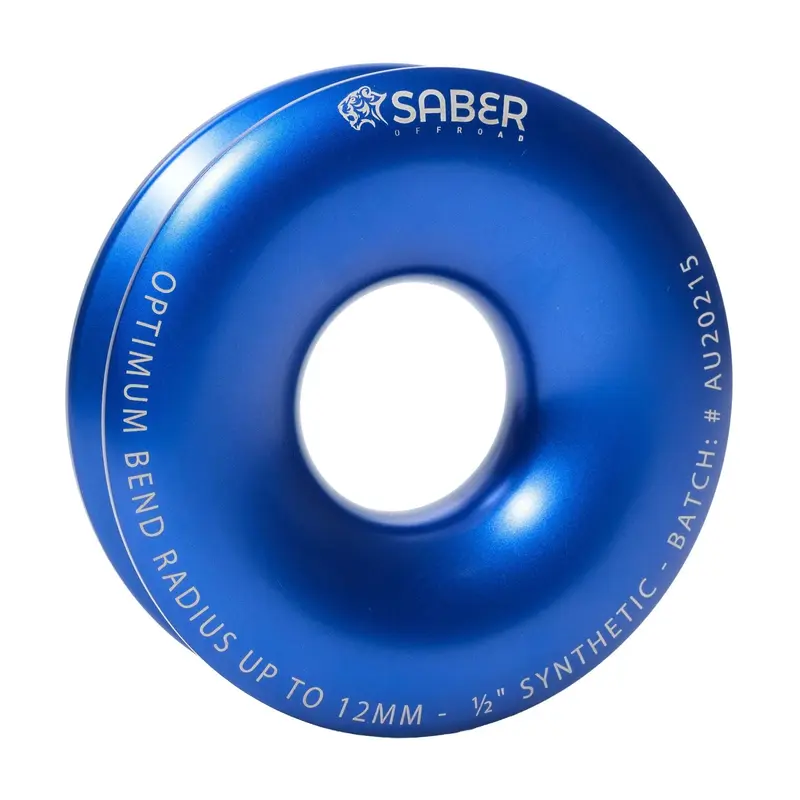
Most recovery rings on the market are compact because smaller means cheaper, lighter, and easier to manufacture. But small diameters come with a price: excessive fibre stress, accelerated fatigue, and reduced rope strength.
Steel cable winches face the same issue — even 3/8-inch wire rope requires at least a 6-inch (152 mm) radius to prevent fatigue cracks. The principle doesn't change just because we've moved to synthetic fibre.
That's why the Ezy-Glide uses a 143 mm outer diameter and a 96 mm internal channel diameter. It looks big because it is big — deliberately so.
For a 10 mm winch rope, that geometry gives a 9.6:1 bend ratio. For 12 mm rope, it's 8:1 — right in the optimal zone for dynamic winching. The thick cross-section (42mm) provides the perfect static bend radius for soft shackles. That means the shackle sits naturally, without kinking or fibre pinch.
As a side bonus, the larger mass and surface area allow the ring to more than adequately handle any heat build up.
In simple terms: the Ezy-Glide’s size isn’t marketing fluff. It’s engineering that protects your rope.
The Ezy-Glide Recovery Ring wasn’t borrowed from a generic casting catalogue and laser-etched with a logo. Saber designed it from scratch, working alongside rope engineers and manufacturers to create a component that genuinely complements synthetic recovery gear.
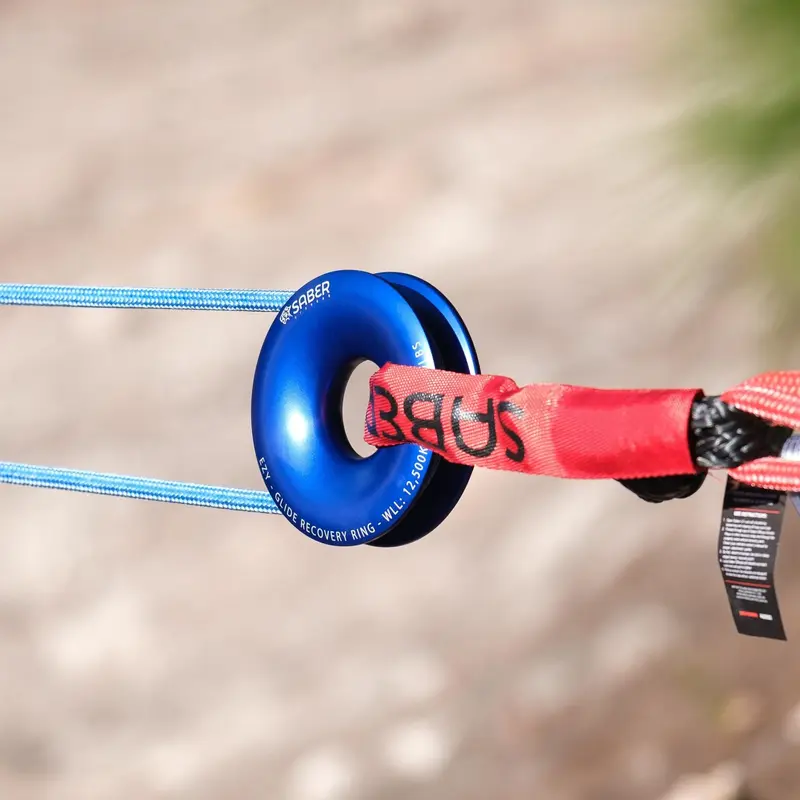
Many recovery rings on the market are "lightweight" because they sacrifice material — and therefore radius. Saber's approach is the opposite: add the material where it matters. The Ezy-Glide's extra diameter and wall thickness deliver the correct D:d ratios for both dynamic rope bends and static shackle bends.
This isn't about being the biggest ring; it's about being the right size ring. The result is smoother operation, longer rope life, and lower fatigue — all without unnecessary moving parts or gimmicks.
Every Saber product begins with a simple question: what's the right way to do this? The Ezy-Glide Recovery Ring embodies that mindset. Backed by testing, physics, and field experience, it's proof that real engineering beats rebranding every time.
By educating the community on bend radius, fibre stress, and correct design, Saber positions itself not just as a supplier — but as the authority in 4×4 recovery gear.
Because in winching, as in engineering, bigger is better when bigger means correct.
A recovery ring is more than a piece of alloy. Its diameter, channel shape, and cross-section directly determine how your rope performs and how long it lasts.
The Saber Ezy-Glide Recovery Ring is intentionally large — providing the ideal bend radius for 10–12 mm ropes, a generous static curve for soft shackles, and ultra-smooth performance under load.
It's the product of engineering, not marketing. Built for people who know the difference.