
1/114 Merrindale Dr
Croydon South, VIC 3136
(03) 8799 2974
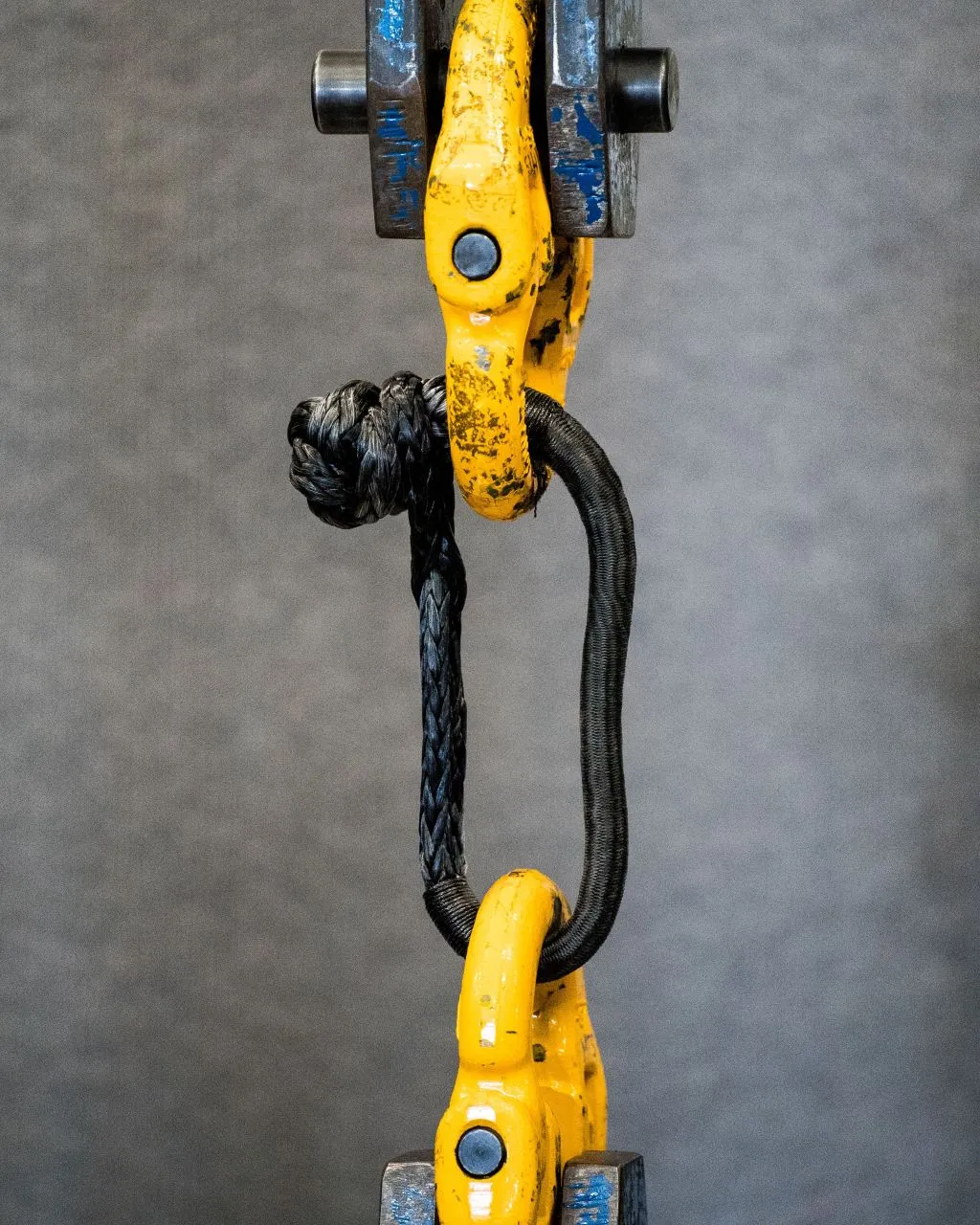
Soft shackles have come a long way. They are lighter, safer to handle, and in most situations they are a better option than steel.
But they are not indestructible.
If you have spent enough time around recoveries, you have either seen one fail or heard about it. When they do fail, it usually gets blamed on sharp edges or cheap gear.
That is only part of the story.
Most people picture a soft shackle failing like a rope being sliced on a knife edge. Clean cut, straight through.
That is rarely what is actually happening.
In a real recovery, especially a winch recovery, you have high load, small contact areas, movement, even if it is slight, and friction. That combination creates something most people do not think about: heat.
UHMWPE (Ultra-High-Molecular-Weight Polyethylene), the fibre used in most soft shackles, is incredibly strong. But it does not like heat. As temperature rises, it starts to lose strength well before it ever melts.
So what you often get is this: the shackle loads up against an edge, it slips slightly, friction generates heat, the fibres soften, and then under load they let go.
From the outside, it can look like a cut. In reality, it is often a heat-assisted failure at the contact point.
Edges do three things:
That combination accelerates everything.
Even a recovery point that looks rounded can still be aggressive under load if the radius is tight enough.
A common assumption is simple: just use a stronger or more abrasion-resistant fibre.
That is where things get misunderstood.
UHMWPE (Ultra-High-Molecular-Weight Polyethylene) is already extremely strong and very abrasion resistant. Aramids like Kevlar are very good with heat and cutting.
But neither solves the whole problem on its own.
Because the failure is not just abrasion. It is load, edge, movement and heat happening at the same time.
The solution is not a single better fibre. It is separating what each material is responsible for.
This is where higher temperature, cut-resistant fibres come into play.
When you introduce a protective layer that can tolerate higher temperatures, resist edge loading, and stay in place under load, you dramatically change how the system behaves.
Not every recovery situation requires a reinforced shackle.
Where you have a large smooth radius, proper support and well-designed recovery points, a standard soft shackle with a protective sheath is often the right tool. In those conditions, the load is distributed properly, the fibres are supported, and the system works as intended.
That is exactly why products like properly radiused rear hitch receivers and purpose-built winch shackles matter. The better the support, the less stress you place on the shackle itself.
Not all protective layers are equal.
Loose sleeves can move under load, bunch up, or expose the core fibres at the worst possible moment.
The more controlled the outer layer is, the more consistent the protection.
That is why the way a protective fibre is applied can matter just as much as what it is made from.
Soft shackles are still one of the best tools in recovery. But like anything, they have limits.
Most failures come down to edge contact, heat generation and loss of fibre strength under load.
If you manage those three things, you dramatically increase reliability.
If you ignore them, even the strongest fibre on paper will not save you.
If you want to see how we have approached solving this in our own gear, have a look at the HDX Soft Shackle. It was built specifically around this problem.